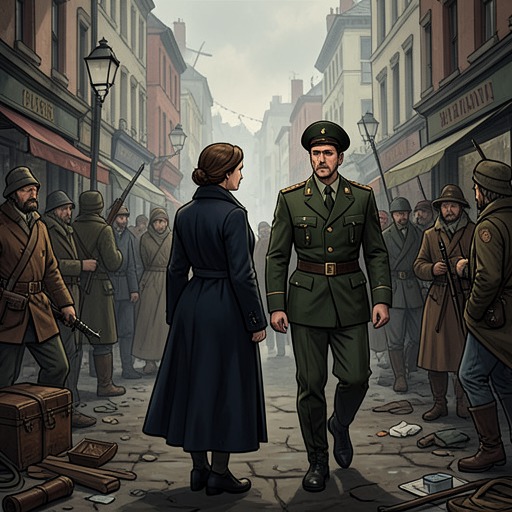
Giulio Giordani
M: Son of the CenturyGiulio Giordani was a former soldier and nationalist minority councilor in Bologna whose death at Palazzo d’Accursio became a turning point in the political meaning of the city’s violence. He was not a Fascist in life; after an anonymous socialist militant shot him during the confused confrontation, however, Fascists made him one in death, honoring him as a martyr and carrying his memory into the streets. His story shows how a contested episode could be transformed into a political inheritance.
Position in Bologna
Giordani served as a minority councilor for the nationalist party in a chamber where political divisions had become inseparable from armed confrontation. He was a former soldier and had received a silver medal. These details locate him among men whose wartime service and public standing mattered in a city increasingly organized around rival political forces, but the account does not present him as a Fascist activist. Indeed, it stresses the distinction: in life, he was not even a Fascist.
That distinction is central to what followed. Giordani’s identity was not simply recorded after his death; it was recast through the way Fascists commemorated him. The gap between the councilor he had been and the martyr he became reveals how political belonging could be assigned retrospectively, through public ceremony and the use of a dead man’s name.
The Palazzo d’Accursio shooting
The killing occurred amid a confused and escalating confrontation inside Palazzo d’Accursio. The building held an armed gathering of socialists, local police, red guards, duty officials, and members of the public. Outside, grenades had been thrown, and bodies were visible through the chamber windows. The socialist councilors, not understanding what had happened, accused the minority councilors of killing their comrades. The nationalist attorney Aldo Oviglio placed his revolver on the table and denied shooting anyone.
In that atmosphere, an anonymous socialist militant stood, aimed at the unarmed minority councilors, and fired. The narrative says that Giordani died instantly. The shooter was never identified by the police or turned over by party leaders. The account connects the act to a reversal of perceived responsibility: the gunman targeted men who appeared to have caused a bloodbath that had, in large part, been brought about by his own comrades. Giordani’s death thus occurred not as a clearly established act of individual revenge, but within a confrontation where confusion, armed fear, and political accusation had overtaken the council chamber.
The wider episode left ten people dead and fifty wounded. Responsibility remained contested, and the account reports rumors that Leandro Arpinati had urged the Fascists to attack or entered the courtyard with a gun, while explicitly distinguishing these claims from what was certain. Against that unsettled record, Giordani’s killing acquired exceptional political weight: his status as an unarmed councilor and former soldier offered a stark image around which the competing accounts could gather.
From councilor to Fascist martyr
On November 23, Fascists marched in formation at Giordani’s funeral procession, carrying the city flag through a crowd that had parted to let them pass. The socialists were absent. They had not called a general strike to protest the Fascist assault, and the council’s members had resigned; by the following day, a prefectural commissioner had taken office. The funeral therefore unfolded alongside a rapid collapse of the municipal political order. It was not only an occasion to mourn Giordani, but also a public display of who could occupy the city’s streets and claim authority in the aftermath.
Mussolini had sent Cesare Rossi and Celso Morisi from Milan to coordinate the formation of Fascist squads. The account describes the paramilitary units as emerging from the bloodshed in Bologna, while Rossi reported the disciplined procession at Giordani’s funeral and the socialists’ absence. These details place the funeral within the Fascist movement’s expansion: mourning, visible organization, and the demonstration of political control converged in a single public event. Giordani’s death was made to signify not just loss, but the apparent defeat of the opposing political force in Bologna.
The response also shaped what happened next. The elected municipal council resigned en masse, and Bologna came under an administrator appointed by the prefect. The account describes the socialist organization’s credibility and the party’s reputation as gravely damaged. Giordani did not bring about these changes by his own actions; rather, his death and its public commemoration became part of the sequence through which the balance of power was transformed.
Political memory and the dead
The Fascist treatment of Giordani belongs to a broader politics of commemoration in which fallen men were not simply mourned and laid to rest. In a later funeral ceremony for three Fascists killed in Ferrara, speakers called the dead martyrs for liberty, and the ritual was described as serving not to bury them but to keep their memory politically active. That ceremony concerned other men, not Giordani, but it clarifies the commemorative language through which Fascists turned death into an obligation for the living: the dead were to be vindicated, and their memory was to accompany continuing action.
Giordani’s place in this narrative rests on the contradiction between his life and his posthumous designation. He was a nationalist councilor and decorated former soldier, not a Fascist, yet Fascists incorporated him into their own story of sacrifice and political legitimacy. His killing helped furnish a movement expanding through organized street power with a figure whose death could be presented as evidence of the other side’s violence. The result was an afterlife in which the uncertainty surrounding the Palazzo d’Accursio bloodshed did not prevent a forceful claim on his memory; it made that claim all the more consequential.